The Balkans: A Short History (Modern Library Chronicles Series Book 3) by Mark Mazower
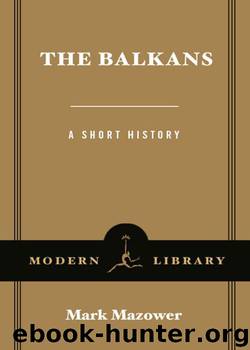
Author:Mark Mazower [Mazower, Mark]
Language: eng
Format: azw3
Tags: History
ISBN: 9780307431967
Publisher: Random House Publishing Group
Published: 2007-12-18T05:00:00+00:00
4
BUILDING THE NATION-STATE
We strained like eagles high above the clouds and now we roll in the dust, in the swamp . . . ! If this is the life a free people leads, then such freedom is in vain. We sowed roses, but only thorns have come forth.
—MIKHALAKI GEORGIEV1
“The claim to set up new States according to the limits of nationality is the most dangerous of all Utopian schemes,” the Austrian Foreign Ministry warned in 1853. “To put forward such a pretension is to break with history; and to carry it into execution in any part of Europe is to shake to its foundations the firmly organized order of States, and to threaten the Continent with subversion and chaos.” Within half a century, the new nation-states of the Balkans had defeated the Ottoman empire; by 1918 the Habsburgs had gone too. The order of European states established at the Congress of Vienna had been superseded by that of Versailles. But as the Hungarian historian Oscar Jaszi observed in a 1925 essay on “The Irresistibility of the National Idea,” the First World War did not solve the nationality problem, since the right of self-determination could not as a matter of practical politics be extended to every national group. Indeed, the existence of both Yugoslavia and Czechoslovakia testified to the continuation of alternative forms of statehood. In the ethnic kaleidoscope of the Balkans, above all, the principle of nationality was a recipe for violence.2
For Ottoman Muslims, the repercussions of Christian triumph in southeastern Europe had long been evident. After the Habsburg conquest of Hungary and Croatia at the end of the seventeenth century, traces of Muslim life and monuments there were eradicated. In 1826 the powers agreed that so far as Greece was concerned, “In order to effect a complete separation between Individuals of the two Nations, and to prevent collisions which be necessary consequences of a contest of such a duration, the Greeks should purchase the property of Turks.” In 1830, the Turks were ordered to withdraw from the Serbian countryside into garrison towns, and thirty years later it was agreed that all Turks not in these towns were to be deported and their property sold.3
In 1876–1878, a new wave of refugees moved across the Ottoman–Serbian border after fighting around NiŠ led to the expansion of Serb territory. Tens of thousands of Muslim Tartars and Circassians fled Bulgaria when the Russian army invaded in 1877; others were massacred by Russian troops and Christian peasants. Thessaly, an Ottoman province, had around 45,000 Muslim inhabitants when annexed by Greece in 1881; by 1911 there were only 3,000 left. In Crete, the Muslim population dropped from 73,000 in 1881 to 27,850 in 1911. Some fled to avoid war, others to escape persecution by bands or civilians or simply such humiliations as having to serve in armies under Christian officers. Organized official exchanges of population—which would become a feature of twentieth-century Balkan politics—were as yet unknown. When the Ottoman authorities proposed an exchange of Turkish and Bulgarian populations in 1878, the idea was rejected.
Download
This site does not store any files on its server. We only index and link to content provided by other sites. Please contact the content providers to delete copyright contents if any and email us, we'll remove relevant links or contents immediately.
| Africa | Americas |
| Arctic & Antarctica | Asia |
| Australia & Oceania | Europe |
| Middle East | Russia |
| United States | World |
| Ancient Civilizations | Military |
| Historical Study & Educational Resources |
Room 212 by Kate Stewart(5130)
The Crown by Robert Lacey(4821)
Endurance: Shackleton's Incredible Voyage by Alfred Lansing(4790)
The Iron Duke by The Iron Duke(4367)
The Rape of Nanking by Iris Chang(4224)
Joan of Arc by Mary Gordon(4119)
Killing England by Bill O'Reilly(4008)
Say Nothing by Patrick Radden Keefe(3992)
I'll Give You the Sun by Jandy Nelson(3452)
Shadow of Night by Deborah Harkness(3377)
Hitler's Monsters by Eric Kurlander(3352)
Mary, Queen of Scots, and the Murder of Lord Darnley by Alison Weir(3216)
Blood and Sand by Alex Von Tunzelmann(3207)
Eleanor & Park by Rainbow Rowell(3185)
Darkest Hour by Anthony McCarten(3137)
Margaret Thatcher: The Autobiography by Thatcher Margaret(3087)
Book of Life by Deborah Harkness(2943)
Red Famine: Stalin's War on Ukraine by Anne Applebaum(2940)
The One Memory of Flora Banks by Emily Barr(2871)
